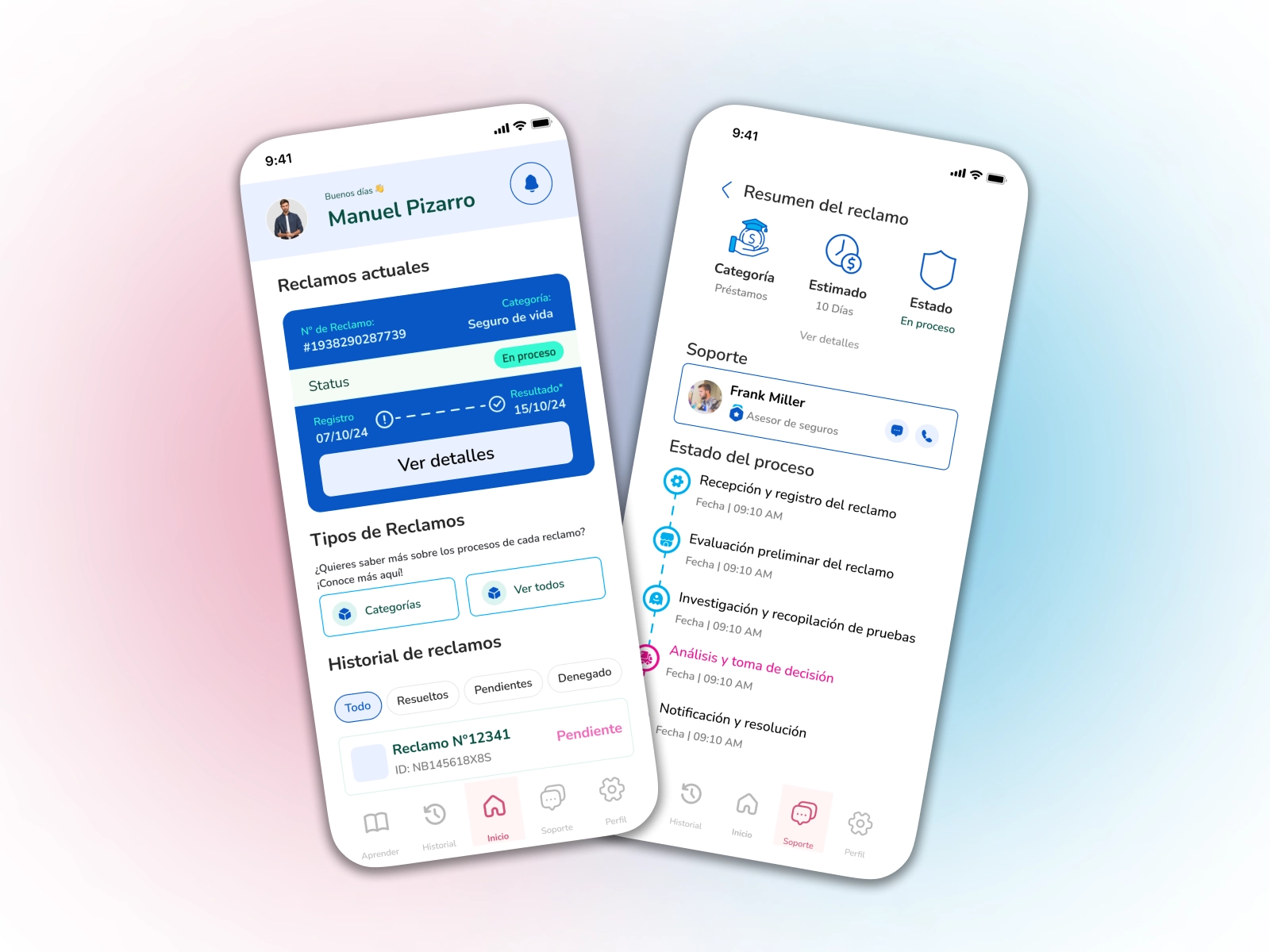
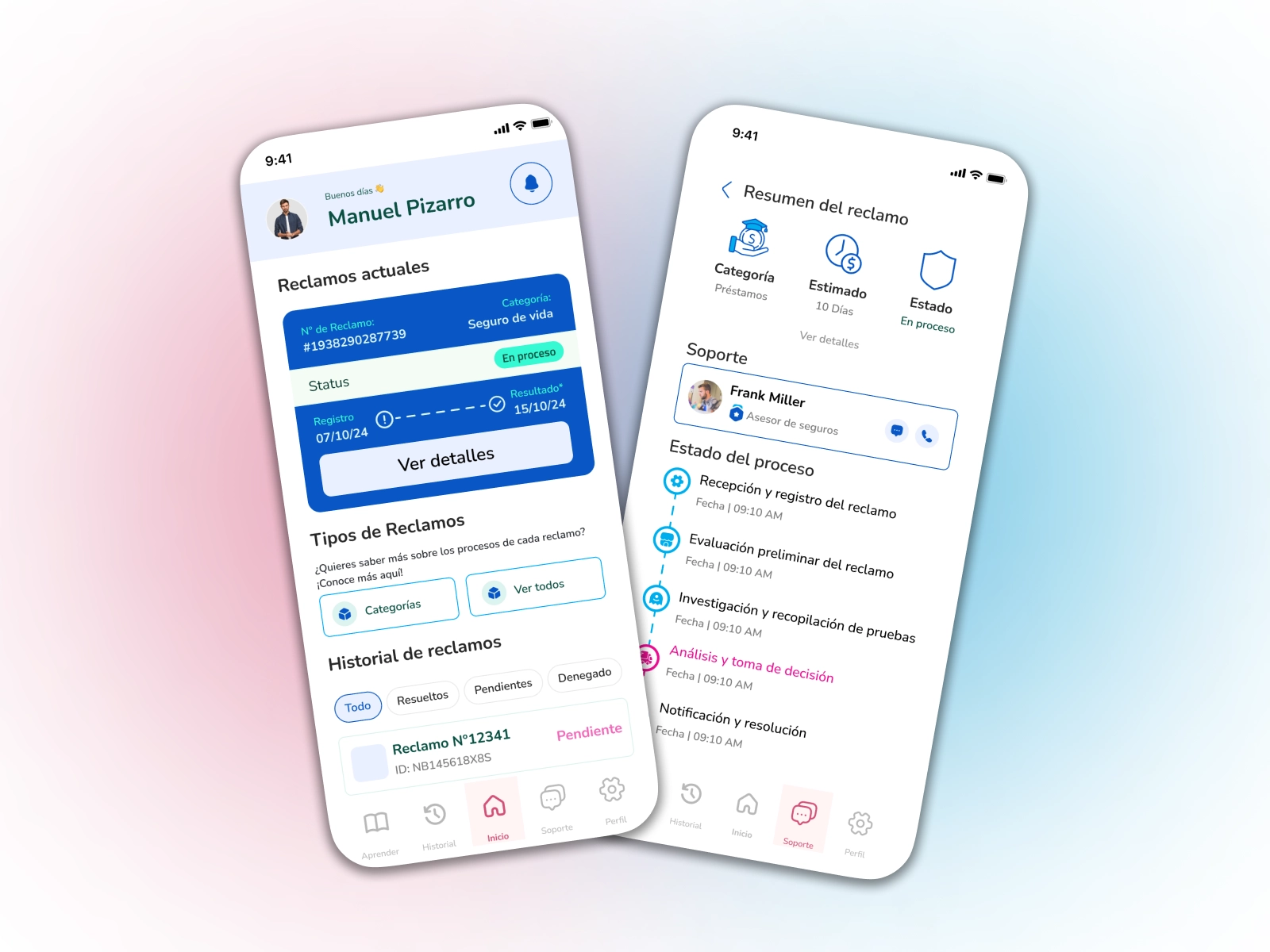
Imagine being an insurer's client, relying on it to protect what you best value, as your health or your home. At the time of an incident that requires a claim, what should be a simple process quickly becomes a series of frustrations: long waiting on the phone line, endless transfers between agents with no context of your case and the feeling of being lost in a process where they appear to speak another language.
The Current Challenge
That's how this company looks. Your customers face challenges due to inefficient monitoring of their claims, preventing them from monitoring their status and creating a sense of uncertainty. The care process is opaque and lacks clarity, and this directly affects the client's satisfaction and thus his reputation.
The Project's goal
The minimum Viable Product (PMV) to be developed aims at providing users with a tool to track their claims in real time, enabling them to manage their case monitoring without constant direct contact with their personnel. The benefits at the corporate level translate into an optimization of resources and an acceleration of the process.
The Expected Impact
It aims at improving its operational efficiency and strengthening its relationship with its customers. By enabling them to manage themselves, an insurer can generate a more fluent experience, increasing customers' confidence and ultimately improving their satisfaction and loyalty.
DESIGN THINKING
To design our solution, that's to add to the company's application, a section where the client can display his claim status as well as his or her history. The Design Thinking process was used with the aim of knowing the client's needs and providing a solution that will bring value and opportunity to the client.
EMPATHIZE
As a first step, we require to have an in-depth knowledge of our client's needs, that's to say, put ourselves in his shoes with the aim of generating solutions.
To do so, the Empathy Map was performed to get to know our customers, their motivation, how they feel, understand their pain and identify opportunities.
He identified everything his client perceives in his environment as well as his words or his feelings internally and concluded that his perception of his and his company's good service and his monitoring of his claims was unsatisfied.
Current product empathy map
To conduct the Empathy Map, first, the client's profile was defined:
- Gender and / or man
- Age: 25 to 60
- Civil status: single or married
- Main activities: Employer or dependent worker
- Where He Lives: Lima
- Nationality: Peruvian
Following this step, the problem currently with the client was identified, which is the lack of efficiency in monitoring the status of claims.
Press enter or click to view image in full size

DEFINE
After meeting our client, we proceeded to conduct the Customer Journey Map, in which we identified the client's low experience at some points of the process, with these being initial waiting for care, interagent derivations and lack of proactive monitoring.
Customer Journey Map of today's product
The Customer Journey Map shows a remarkable fluctuation in customer satisfaction throughout its experience with critical points in initial waiting and derivations. The most problematic areas are:
- The initial wait at the care tail.
- Connections or transfers between agents.
- Lack of proactive monitoring.
That's why, to improve our client's experience with our proposal, we aim to implement:
- Reduction in waiting and tail times.
- Retirement and case monitoring improved.
- Monitoring automation.
- More common and custom notifications.

IDEATE
After knowing about the client's problems, a rain of ideas was generated with members of the potential solutions team.
To this step, the Spater tool was used, and the best solution for the current problem was to add to the application a tab with the client to know the status of his claim and his or her claim history since his or her purchase of his or her service.
Scamp

Value proposal
The value proposal currently being put forward focuses on improving user experience through an efficient and accessible digital system to manage claims, as there have been identified areas where system speed, communication clarity and information security can be optimized.

User Flow

ProTOTIpED
To respond to the challenges identified, the solution was put into practice with an application of consultations integrated into the company's digital services. Below is an overview of the screens that will form the MVP and followed by these are the two main flows that will form them.
The following link can be found at:Link to interactive prototype


First, our demand monitoring system offers users the ability to monitor their claims status in real time, providing complete transparency and access to complete details of their case. The users can visualise every step of the process that's been run by the company, and they are constantly aware of their demand's progress. Also, for more comfort and support, users have the option to contact an advisor directly by phone call or message, thus facilitating smooth and efficient communication if they require additional assistance or solve specific concerns.
Secondly, to facilitate a more clear and detailed understanding of claims procedures, we have developed a dedicated section where users can explore the different categories of procedures. That area explain in a transparent and step-by-step manner how the company addresses and resolves each demand to achieve a satisfactory solution. In providing this information, our goal is to ensure that users have a complete understanding of the processes involved and the methodology we apply to ensure fair and efficient results. That openness not only improves confidence in our services but also lays down a framework for transparency that we deeply appreciate.
TESTING


LEAN
Use of 4 lean principles in the organization
The Just In Time (JIT) system aims at ensuring that services are delivered at the right time and place and eliminating any waste that does not generate value. In the context of an insurance company's claims platform, applying the Lean methodology aims at improving communication with customers, ensuring efficiency in their demand management and increasing satisfaction by providing precise and timely information about their claims status. The following describes how the Lean Principles are implemented in this system:
Flow
The flow principle ensures that demand monitoring activities are continuous and continuous. Currently, the identified bottle necks include long times to update claims status and lack of automated notifications for customers. To improve the flow we propose:
- Digitize the whole demand monitoring process using a track system that allows real-time status viewing.
- Implement automatic alerts by push notifications at every step change of the claim.
- Automate repetitive tasks, such as agent assignment for more complex cases, using predictive systems.
These measures seek to reduce dead times, increase process transparency and minimize uncertainty among customers.
Pull
The Pull principle ensures that resources are used only with a real demand. In the case of the claims platform, this means activating the actions of the system only when the client submits a query or when the claim changes status. To implement this principle:
- To develop an interface that will allow customers to consult their claim status at any time without contacting their staff.
- To integrate prioritization tools based on case urgency or time from start
- Replacing manual monitoring with a dynamic system that optimizes assignment of tasks to staff as currently charged
That will reduce assignment of tasks, optimize agent time and improve client experience.
Rhythm
The rhythm or "takt time" defines the predictable cadence for updates and closure of claims. To set this rate means balancing operational capacity with customers expectations. To define an appropriate rhythm:
- Analyze historic data about mean demand resolution times to identify high and low demand patterns.
- To set standard deadlines for each stage of the process, as the maximum time allowed to answer inquiries or solve simple cases.
- Synchronize system tasks with agent activities, ensuring that notifications reach customers in real time.
These actions will contribute to improving service predictability, increasing customer satisfaction and optimizing operational burden.
Zero defects
The Zero Flaw principle aims at preventing errors at every stage of the claims process, which is crucial to maintaining customer confidence in the insurance company. The following actions are proposed:
- Implement automatic validation on the platform to avoid data entry errors or assignment of tasks.
- To design a centralized system that keeps a single and up-to-date registry of each claim, eliminating redundancy and guaranteeing precise information.
- Training care personnel in using tracking and effective communication technologies.
The measures are intended to significantly reduce administrative errors, improve information accuracy and strengthen customer confidence in the company
LEAN START UP
Supposments of faith:
Three fundamental considerations of faith have been identified as vital beliefs or statements requiring validation by the client. These assumptions have been carefully incorporated into a prioritization matrix, enabling us to evaluate their importance and urgency in terms of validation. That methodology ensures that every assumption will be scrutinized and validated through direct interaction with customers, thus ensuring that our business model is aligned with market needs and expectations. That approach not only strengthens our plan's credibility and viability but also strengthens our capacity to make strategic decisions based on actual data and direct feedback from our users.

Priority matrix
The prioritization matrix has been essential to highlight the most influential faith assumption: "The increased process management by the client will reduce the need for direct support, enabling an optimization of customer care resources and a significant improvement in end-user satisfaction, enriching their use experience." That approach not only facilitates better use of our care resources but also empowers users, making them more autosufficient and improving their perception of our services. That assumption is vital as it directly links internal operations with our clients' expectations and conduct, providing a solid basis for more effective and efficient service strategies.
Minimum Viable Product:
After identifying the most influential faith assumption and analyzing client problems through detailed polls, we have established that our Minimum Living Product (PMV) will be a demand monitoring system. That system will allow customers to independently manage and monitor their claims status. That self-management capacity does not only improve efficiency by reducing the need for direct intervention by the support equipment but also optimizes our customer care resources. Moreover, this monitoring system is expected to significantly enhance customer satisfaction by providing transparency and monitoring about the demand resolution process and thus improving its global experience with our services.
Create - Mid - Learning
To measure that the proposed product is feasible. The following indicators shall be used:
- Percentage of users entering system
- Frequency of user inquiries
- Reduction of calls for inquiries about claims
- Average time to solve a claim
These indicators are essential to measure the impact of the new project on our company and to evaluate how the customer demand care process has improved. Following the initial validation of the project, we will identify areas for improvement and make incremental adjustments to ensure that we achieve our established goal.
SCRUM
The implementation of the Scrum methodology relies on the capacity of this framework to manage complex projects and adapt to the client's needs in an iterative manner. as mentioned by Schwaber and Sutherland (2020), this approach is important to generating value to people, teams and organisations through adaptive solutions to complex problems. That was the case with the insurer, with the problems of transparency and traceability in demand processes. In addition, Scrum promotes continuous collaboration between multifunctional teams and stakeholders, enabling them to align business priorities with customer expectations (Rubin, 2013). In this context, Scrum's iterative and incremental approach allows constant product adjustments through short work cycles, ensuring that each Sprint delivers tangible and aligned value with the company's aims.
PRODUCT BackLog

EVENTS: SPRINT PLANNING
Sprint
Being the core of the Scrum frame, it represents an iterative and limited work cycle at the time where the equipment undertakes to complete a set of tasks to deliver a functional increase. To this end, the main goal is to develop the functionality of tracking, responding to the central problem of the lack of transparency and traceability in the process of resolution of cases reported by customers. Thus, achieved value by solving pain points in these areas and optimizing client experience
How the following sections will be developed, while planning, established the necessary tasks atSprint BacklogIt includes 15 elements ranging from initial research to development, integration and performance tests.
Sprint target
To develop and implement the demand tracking system, ensuring that customers can clearly visualise the current status of their claims, outstanding steps and estimated resolution dates, providing more transparency and confidence.
SCRUM equipment
Pre enter or click to view image in full size

Sprint duration
Sprint duration
3 weeks (3 working days).
The increased duration allows a better focus on validation and feedback-derived adjustments, ensuring the quality of the tracking system before delivery.
Definition of Fact (DOD)
- All functionalities have passed with unitary and functional tests.
- The interface design is intuitive, responsive and compatible with mobile and desktop devices.
- The data shown are correctly updated from the real-time database.
- A final validation by the Product Owner has been completed and is ready to be deployed.
- The system's technical documentation has been finalized and is available to equipment.
- The tracking system is integrated and functional, enabling users to:
- See your claim's summary (number, category, registration time and date).


SPRINT BACKLOG

Daily Scrum:
The Daily Scrum, tries to get development team to sync and plan its daily work. According to Schwaber and Sutherland (2020), "The Daily Scrum is a 15-minute event that takes place every day during the Sprint, where developers inspect progress towards the Sprint target and adapt the Sprint Backlog as necessary."
For this project, a review of the status of tasks will be undertaken on the KANBAN board. The review will have two specific objectives: first, to safeguard the application of the "Pull" principle of the LEAN framework in the delivery process. Due to the dependent nature of the components, the completion of each deliverable will be the starting point for the start of the following. Thus, the elements developed will maintain cohesion between them.
Second, to ensure that the development process remains effective by identifying potential signs of "Bottle necks" and by ensuring that a saturation of tasks at Work in Progress isn't generated. To identify a "Overload" situation, reorganize resources to remedy the flow.
9.1.2.4 Sprint Review:
To be the last meeting that takes place at each Sprint, this includes participation by both the Scrum and the key Stakeholders. That's why his intention refers to presenting his advances / results as well as being the best opportunity to inspect "Increments," Knapp, Zeratsky and Kowitz (2016).
It will start with a brief introduction of the Scrum Master, who was charged with setting the aims of the Sprint. To be established the "Increase" of this Sprint by the order monitoring feature. The development team will propose to interested parties the functions implemented and how these contribute to the product's objectives. During the demonstration, an emphasis will be placed on how these features will improve the user's experience and will collect the immediate comments from stakeholders. Those comments will serve to identify potential improvements or adjustments prior to launch.
At the end, the team will discuss the status of the Backlog product, prioritizing new ideas and suggested adjustments so that the computer can effectively adapt and plan the next Sprint. Thus, we seek to maintain transparency in collaboration and communication between the development team and to ensure that development is aligned with the expectations of the business and end-user's needs.
9.1.2.5 Retrospective Sprint
It aims at evaluating and optimizing how the team managed its work during the Sprint. The last space event will allow us to inspect the practices implemented, identify areas of improvement and propose concrete actions to increase the effectiveness of future iterations.
In this context, the Scrum team is expected to reflect on key issues such as interplay and communication among its members, challenges management, applicability of Factual Definition (DOD) and internal collaborative dynamics.
INCREMENT
How can you display in the UI Section of this paper, the increase that will be delivered at the end of this sprint will be a feature of matching claims integrated into the platform, enabling users to display clear and detailed key information about their claims with two main widgets. The first will provide a summary with essential data such as the claim number, category, date of registration and estimated date of resolution. The second will visually display the current status of the demand within the resolution process, highlighting the completed phases, challenges and general progress.
That solution generates a more transparent monitoring period and became more confident about the company. The problem of traceability was also addressed by enabling customers to understand the complete flow of the resolution process, reducing the need for additional consultations.
Finally, acceptance criteria include the user's ability to access the tracing section and display precise information about their claims as well as the proper functioning of the real-time update of the resolution status. It will also be evaluated that the interface design meets standards of usability and accessibility. The final validation by the Product Owner guarantees that the increase will meet initial requirements and will have an expected impact on the client's experience.
KANBAN
Reason
How will be developed in the next Section, the project will be developed under the SCRUM work framework. Thus, KANBAN will be employed to manage the work performed by the team, as the main virtue of this tool is to be able to visualise the work flows performed during the Sprints visually. It will co-ordinate with the introduction of contingency measures to avoid work overload and to avoid Muda and Muri's training in the Lean environment. As a result for the equipment, adaptive and change response capacity will also be developed as a result of the search for value development for the insurer's customers..
Kanban board
To illustrate and contextualize the use of the tool in the project, a Kanban board representation has been created to reflect the status of work performed by the team during the second week of the Sprint.
The Kanban board used for the project is structured into five fundamental phases that secure an organized and efficient workflow. The "Backlog" column includes all tasks to be performed at today's Sprint. The "To Do" column houses the tasks selected to start at once, with an emphasis on top priority and avoiding overload. The jobs are later advanced to "In Progress," where work that's currently under development. Once completed, they move to the To Verify column, where they are undergoing review and verification processes to ensure quality, alignment with requirements and compliance with the Fact Definition (DOD). Finally, while passing to the Die column, this indicates that they have been finalized and ready to be delivered.
Kanban board

Kanban Métrics
Lead Time
That indicator has been determined by measuring how soon a task enters the To Do column until it reaches the Do column. For complete tasks, "To design system wireframe" or "To create initial test checklist," an estimated average delivery at aboutA week.
Delivery Rate
The delivery rate reflect the number of jobs completed within the time period evaluated. In the second week of the Sprint, the team has been complete3 taskssignificant.
Ongoing work (WIP)
It's applied with the aim of preventing equipment saturation with too many simultaneous tasks, promoting approach and avoiding resource dispersion. Obtained with the calculation of the number of tasks that have been activated on the Kanban board at a given time. In this case, three tasks are shown in column In Progress and two in To Verify, amounting to a total of4 elementscurrently under way.
OUTCOMES
10.1 Measuring impact / outcomes
We use the Outcome Based Planning (OBP) as a key strategy to focus on our main goals, with an innovative approach that promotes continuous collaboration and teamwork. That approach is designed to create a substantial impact and added value for our customers. Specifically, we apply the OBP p to revolutionize the client's experience in monitoring claims, facilitating access to your case tracking. That method improves transparency, increases the agility of the process and strengthens customer confidence, leading to better satisfaction and better relations with them.
10.1.1 Basic concepts
Where's she going?That approach is designed for the final client, with the aim of ensuring a positive and efficient experience with monitoring their inquiries and / or claims.
What will I do and I will not?A new tracking system will be put into place and integrated into the secure area of the portal to promote self-management. That system will assist customers with monitoring their cases, offering multiple benefits and improving their user experience. Nevertheless, it will avoid overburdening the client with complicated processes that can make information more difficult.
How will I know I'm here?The success of this implementation will be measured through several indicators: notifications received by customers through channels such as email and WhatsApp, resolution time of cases, level of client satisfaction and number of interactions by consultation about the status of requirements and / or claims. These parameters will allow us to evaluate the system's effectiveness and to adjust our strategies as necessary.
Objective:
To increase the self-management of case monitoring to improve transparency and efficiency in customer demand and demand management.
Key Results:
- Implement an automatic reporting system for monitoring claims:Develop and implement an automated system that sends notifications to customers about the status of their demand at every critical stage of the process with the fully operational and tested system for the end of sprint 1
- To achieve real-time update of monitoring on the platform:Ensure that 100% of claims entered into the platform are updated in real time, showing all phases of the process clearly with dates and specific details of progress, by end of sprint 2
- To increase customer satisfaction with the transparency of the process:To achieve that at least 85% of customers expressed a significant improvement in their status and visibility in satisfaction polls by the end of sprint 2
Objective:
Optimize and expedite the demand management process to improve the client's experience through the demand typology guide or case consultations.
Key Results:
- To develop and launch an interactive online platform at two spots to guide customers with their claims categorization:The first sprint will focus on front-end design and development while the second sprint will complete backend integration and user testing. The launch is scheduled for the end of the second sprint.
- Implement improvements to the automatic grading system through three sprints to reduce the time for reclassification of malcategorized cases by 50%:During the first sprint, current classification algorithms will be revised and optimized. In the second sprint, new user feedback-based features will be developed and tested. The third sprint will be dedicated to final implementation and impact measurement