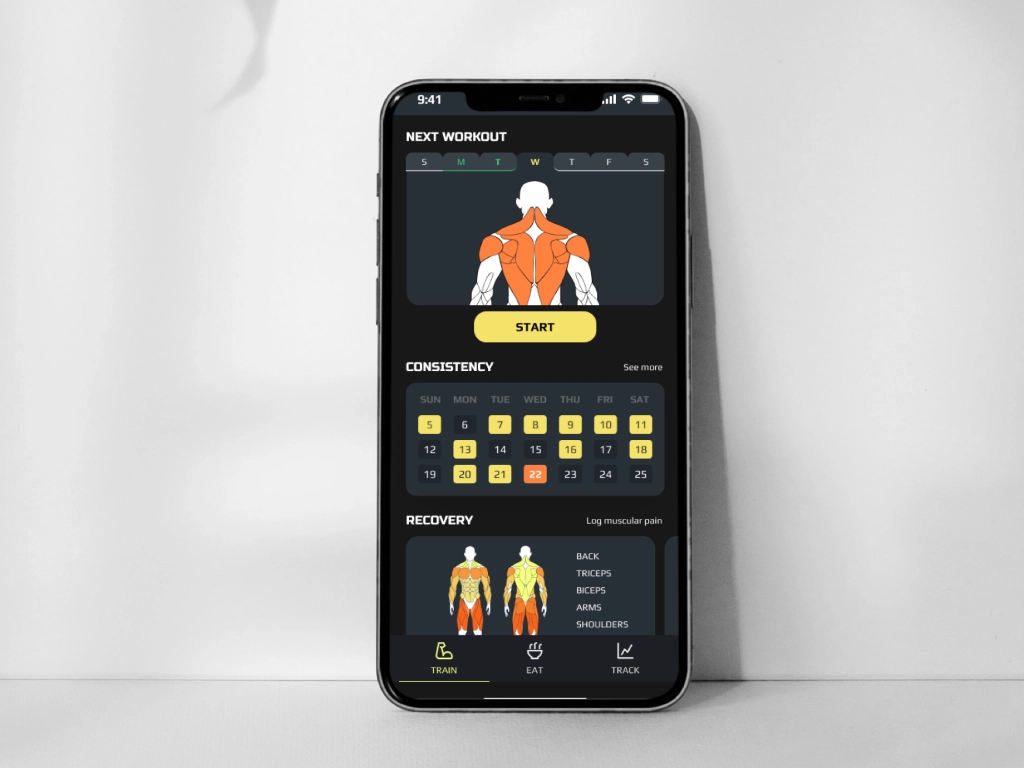
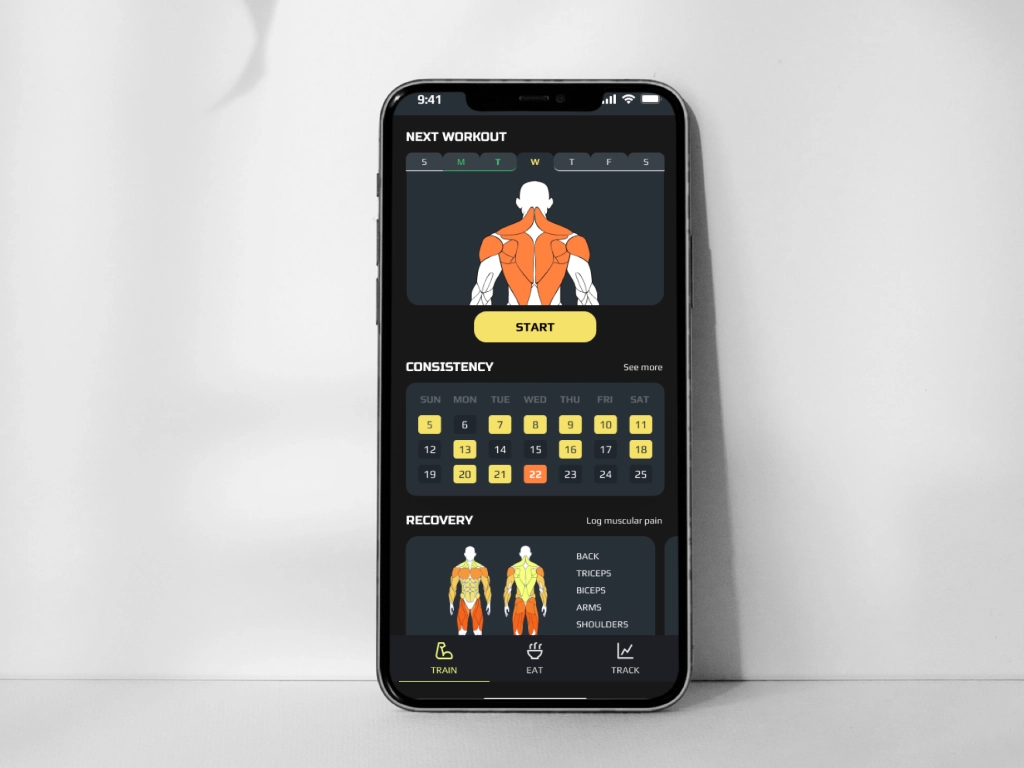
BULKMATE
Bulkmate is a solution that allows ectomorphics that seek to increase their muscle mass by training weights, to improve their performance and protein intake. Monitoring their progress and providing them with strategies to improve their training and feeding.
Problem
To develop muscle mass, one if not the main goal of training weights at the gym. Thus, this discipline is adopted by different people. For ectomorphics, however, this task can be twice as complicated, as his body's tendency to lose weight quickly.
The situation became more complicated if they did not have the necessary advice to face their sessions or simply lacked the necessary knowledge because of their inexperience. Proclaiming his work at his sessions isn't effective, wasting time and energy, leading to his abandonment and his injuries.
Resolution
To assist them with this process, I developed an application that addresses the main factors that influence muscle mass development. In the training area, you will guide them to select useful exercises to stimulate different muscle groups and to ensure their proper performance. Similarly, it will allow them to plan their training sessions so that they can best distribute their energy and muscle recovery.
On the food side, they will be able to visualise the amount of protein consumed during the day so that they can reach the daily targets necessary for muscle growth. Besides providing them with food alternatives that help them reach their goal.
All this includes a constant monitoring of his progress. Allowing them to visualise their physical changes in the process, as well as to evaluate their performance in both training and feeding to conduct corrective measures and maintain their motivation.
PROCESS
EMPATHIZE
DESK RESEARCH
Let's start by understanding our users' goal. To this end we have to understand what factors influence the development of muscle mass. To that end, I did a research desk about the process and condensed them into 3 main pillars.
1. Intensive training with a proper technique and prioritizing composite exercises.2. Food high in calories and proteins, at constant intake throughout the day.
3. Monitoring of weight and performance to optimize the process.
USER INTERVIEWS
Once we have been considering our thematic areas, we have come up with the questions for his interview. To first-hand understand how they are addressing this challenge and also what its main challenges are.
DEFINE
AFFINITY DIAGRAM
The next step was to conduct an affinity diagram to conduct visually the ideas obtained from interviews. Product of clustering themes, I have been able to identify the main themes, scenarios and strategies that users use in the muscle gain process. It also allowed me to identify common pain points at different stages of its areas.
Press enter or click to view image in full size

USER PERSONA
When I analysed the clusters drawn up in the affinity diagram, I was able to validate the hypotheses of my target user's pain points. Nevertheless, I have identified differences relative to training time and perceived progress in their performance. That allowed me to draw up two user profiles that would serve as a guide for later design phases.
Press enter or click to view image in full sizePress enter or click to view image in full size


USER JOURNEY
Having identified the actions and pain points users experience on a training day. He proceeded to organize them secutionality in a Journey Map, structured at the above-mentioned pillars (Food, Training and Monitoring). When analyzing the relationship of actions with each other you can identify how pain points influence them and accordingly understand their degree of intensity to prioritize the solutions to be implemented. On the other hand, having a broad perspective of actions helped me to identify opportunities for improvement under every circumstance.

IDEATE
JOB STORIES
With the aim of developing solutions that will allow users to undertake actions that bring them closer to their goal. I chose to adopt the Jobs to be done methodology as this prioritizes the development of solutions that are relevant to the user's aims, building on the tasks that this aims to achieve in specific situations.

FEATURE PRIORITIZATION
Although the Jobs to be done outlined the range of solutions generated by the idea, it was imperative to define a list of main features for their implementation of an MVP (minimum feasible product). To have a number of basic features will allow you to validate if the solution will really be bringing value to users as well as facilitating efficient time assignment at the design stage. A MOSCoW Matrix was used for this goal.
Press enter or click to view image in full size

USER FLOWS
Having defined the main features of the application. User flows at common start points were organized for each area.
Press enter or click to view image in full size

FUNCTIONING
Press enter or click to view image in full size

FUNCTION
Press enter or click to view image in full size

PROGRESS
INFORMATION ARCHITECTURE
Press enter or click to view image in full size

DESIGN WIREFRAMESPress enter or click to view image in full sizeMEDIANA FIDELITY

Press enter or click to view image in full sizeALTA FIDELIDAD

_
Press enter or click to view image in full size

Fears
Press enter or click to view image in full sizePress enter or click to view image in full sizePress enter or click to view image in full size


Press enter or click to view image in full sizePress enter or click to view image in full sizePress enter or click to view image in full size


Press enter or click to view image in full sizePress enter or click to view image in full size

